How to Become a UGC Creator: A Practical Beginner Guide
To start as a UGC creator, choose one kind of content you can make, create honest practice samples, and show a suitable buyer exactly what you would deliver. A useful first offer is specific: for example, one captioned product demonstration with a defined length, revision round, and intended use.
Follow the notebook example below from brief to storyboard and pitch, then use it to plan and film your own sample. The drawings and scripts are practice materials; they are not a finished video or a client campaign.
Templates to use with this guide
- UGC project scope worksheet — TXT
A blank planning worksheet covering deliverables, reviews, payment, usage, permissions, and handover. It is not a contract.
- Three concept scripts and shot lists — TXT
Original notebook demonstration, on-camera explanation, and voiceover walkthrough scripts with caption text and production notes.
Start with the deliverable a buyer needs
In commissioned UGC work, a business may buy a video, set of photos, or other customer-style content for agreed distribution. You may be hired to produce files without posting to your own audience. That makes the ability to interpret a brief, communicate clearly, and deliver usable work more relevant than simply collecting followers.
Ask what the viewer needs to understand after watching. “Show how the notebook can hold a short daily plan” is a production objective you can demonstrate. “Increase the brand’s sales” is a business outcome you cannot promise from one untested video.
Choose one starter service
Begin with an object or topic you can explain accurately using equipment you already have. Try your phone, a stable support, a quiet room, and available light before buying equipment. Record a short test and check that the subject is in focus, the words are clear, and the shot is steady.
| If you can… | Try this practice service | Keep the first scope narrow |
|---|---|---|
| Film a clear close-up | A hands-only product demonstration | One object, one task, one final vertical edit. |
| Explain something naturally on camera | A short explanation with supporting detail shots | One audience question and a script grounded in observable facts. |
| Narrate a sequence and edit screen recordings | A voiceover walkthrough | Use your own mock interface or an authorized demo account; remove personal data. |
| Compose and light still images | A small product-photo set | Three specified views with consistent light and a written shot list. |
Start with this sample brief
The example uses an unbranded notebook with three handwritten headings. Substitute something you already own and adjust the script to what it actually does.
Concept brief: a three-line desk plan
Sample status: a practice brief and storyboard, with no client or filmed video.
Audience: someone opening their laptop with several small tasks competing for attention.
Viewer task: see one simple way to write a priority, a next action, and a follow-up on paper.
Deliverable to practice: one approximately 25-second vertical demonstration, with narration and readable captions. Timing is a drafting target, not a platform requirement.
Core message: a blank page can hold a small, specific work plan. Show the headings and a fictional filled example.
Required shots: blank notebook; hand writing the three headings; close-up of the completed page.
Claims to avoid: measured productivity gains or time savings that the demonstration cannot establish.
Audio and assets: original narration and room sound; no music, logos, customer records, or other people.
Practice destination: a clearly labeled portfolio sample. Any later commercial publication requires its own agreement and platform checks.
Turn the brief into shots, script, and captions
Use the storyboard to plan your shots. Read the script aloud and adjust the suggested timing to your delivery. Each caption matches the narration below.
Record clean narration at a steady distance from the microphone. Put captions where they do not cover the writing; check the final crop on a phone. Start without music so the words and hand movements carry the explanation. If you later add audio, record the relevant commercial-use permission for the actual destination.
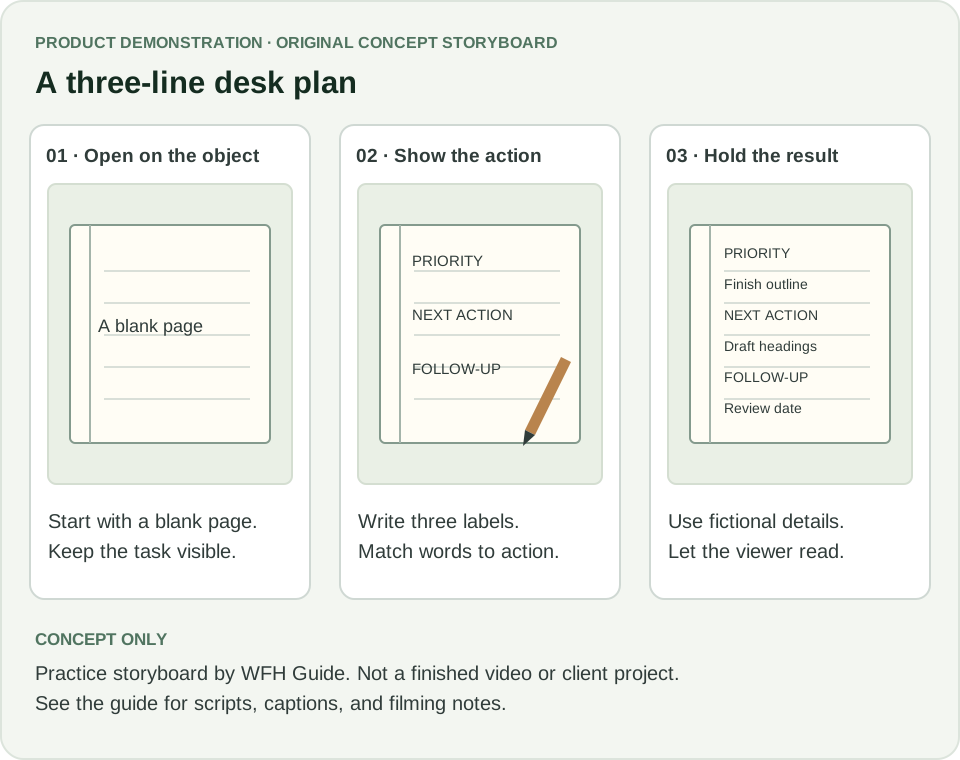
| Time / shot | Narration and matching captions | Direction and check |
|---|---|---|
| 0–5 seconds: overhead opening | “Opening your laptop with too many loose tasks? Start with three lines.” | Open on the page, not an unrelated room tour. Keep the concept label visible in the sample. |
| 5–14 seconds: close-up writing | “Write one priority, its next action, and anything you need to follow up.” | Write PRIORITY / NEXT ACTION / FOLLOW-UP. Hold long enough to read each label. |
| 14–22 seconds: filled page | “For this example: finish the outline, draft three headings, and confirm the review date.” | Use fictional notes. Do not include real client names, email addresses, or confidential work. |
| 22–25 seconds: final overhead | “Try the layout on a page you already have.” | End on the completed page. The call to action matches this unpaid educational concept. |
Review a sample before adding it to your portfolio
If you offer filmed content, show a finished video you made. Use this storyboard to practice, then replace it with your own recording in your portfolio.
- 1Check the brief against the final file.Can a viewer see all three headings and understand the filled example? Remove attractive shots that obscure the task.
- 2Watch once with sound off.Captions and visuals should still communicate the sequence. Correct auto-caption errors and leave enough time to read.
- 3Listen without looking.The narration should make sense, avoid unexplained references such as “this thing,” and contain no distracting noise.
- 4Inspect the exported file.Check the opening and ending, caption edges, focus, orientation, and any accidental personal information. Keep an editable project copy.
- 5Match the portfolio description to the sample.A storyboard shows planning; a recorded sample also shows filming, delivery, editing, and audio. Describe those skills without adding sales or advertising claims you have not measured.
Choose complementary portfolio samples
Select pieces that let a buyer judge your service. A demonstration, an on-camera explanation, and a voiceover walkthrough show different skills; three nearly identical unboxings may tell a buyer less. Start with your strongest work rather than a fixed sample count.
For each piece, state the audience, task, your contribution, what exists, and whether it was commissioned. Use a label such as “Unpaid practice sample — filmed and edited by me; no brand involvement.” Keep concept work separate from any later client work and get permission before showing confidential or restricted material.
Prepare a pitch around one useful idea
Review a potential buyer’s public website and current content. Identify an observable gap: perhaps the product page explains the materials but does not show how the object is used. Treat that as an idea to discuss, not proof that the existing marketing is failing.
Adapt the pitch below for a notebook business whose content you have reviewed. Replace the observation with something you actually noticed, and use its requested submission route or a relevant public business address. Personalize each message and respect a refusal.
- Why the opening worksIt links the idea to something the recipient can verify, rather than an exaggerated claim about the brand.
- Why the sample mattersThe link lets the buyer assess work you actually made. Label a storyboard as a storyboard, and link to a finished video if you are offering filming and editing.
- Why the scope stays provisionalWhere the content will appear, paid advertising, product shipping, deadlines, and revisions can change the quote. Confirm those details before starting work.
Sample pitch: a specific demonstration
Subject: A three-line notebook demo idea for your product page
Hello [name],
I noticed [specific, accurate observation about the notebook page]. A short overhead demonstration could show a viewer how to turn a blank page into a priority, next action, and follow-up.
I create [your actual service]. Here is a clearly labeled practice sample showing my approach: [your working portfolio link].
My proposed starting deliverable is one captioned vertical demonstration, with a script for approval and one defined revision round. I would confirm the intended channels and usage period before quoting.
Are you the right person to discuss this idea with? If it fits a current brief, I can send a concise scope.
Thank you, [your name]
Scope the project before agreeing to a fee
Use the blank worksheet to turn an interested reply into concrete questions. Define what is included, who approves it, and how changes are handled. Keep the production fee distinct from any agreed permissions, distribution work, expenses, or exclusivity.
Here is a hypothetical cost calculation in US dollars: 1 hour for briefing, 1 for scripting, 2 for filming, 2 for editing, and 1 for review and delivery adds up to 7 hours. At an assumed $30 an hour, plus $15 in direct costs, the production fee would be $225 before taxes and any separately agreed usage fee. This illustrates the calculation, not a typical beginner rate. Use your own time estimates and costs.
| Area | Write down |
|---|---|
| Production | Number of final files, target length, orientation, captions, versions, and whether source files or raw footage are included. |
| Reviews and timing | Script approval, the number and meaning of revision rounds, who supplies consolidated feedback, due dates, and handling of reshoots or changed briefs. |
| Payment and expenses | Fee components, currency, invoice and payment dates, any stages, product shipping/returns, and responsibility for costs. |
| Usage | Named channels, organic or paid distribution, period, territory, editing permission, and whether the creator may display the work. |
| Additional permissions | Account-based advertising access, exclusivity, likeness or voice reuse, AI-related reuse, and any separate approval required. |
| Handover and changes | File delivery, storage period, cancellation, corrections, and the process for approving extra work. |
Check rights and disclosure before publishing
For US-facing endorsements, the FTC says recommendations must reflect honest opinions and experiences; an unexpected connection that affects how people evaluate them may need clear disclosure. Payment and free products can matter. Do not turn a practice sample into a fabricated customer testimonial.
For a YouTube assignment, check its paid-promotion requirements: qualifying commercial content must be declared to YouTube, and the uploader remains responsible for applicable disclosure obligations. Other platforms have their own requirements.
Keep an asset record for images, music, footage, and screen content. The US Copyright Office explains that original photographs can be protected from creation and that authorship can differ in work-for-hire situations. Owning a product or finding a photo online does not itself give you permission to reuse someone else’s photograph.
Get permission before filming other people or posting their personal information, as YouTube’s privacy guidance recommends. Avoid real customer details, private messages, and unapproved workplace screens. Recheck the linked guidance when preparing a live assignment.
Use your first attempt to estimate the next project
Try four practice sessions: write the brief and script; capture footage; edit and review; then prepare the portfolio caption and pitch. Note how long each session takes so you can estimate similar work more accurately.
Track planned and actual time, unclear feedback, revisions, missing assets, and what caused a reshoot. If a 25-second demonstration takes longer than expected, identify the step that needs practice before adding more formats. After any real project, record only outcomes you can substantiate and have permission to share.
Frequently asked questions
Can I become a UGC creator with no experience?
Yes. Begin with a narrow service and clearly labeled practice work. Show the finished sample, explain your contribution, and use it to find out which production skills need more practice before approaching clients.
Do I need followers to start UGC work?
A production-only assignment may not require you to publish to a personal audience. If a buyer also wants access to your audience, treat that as a separate distribution responsibility and confirm its requirements.
What should I put in my first UGC pitch?
Include a specific observation, one relevant content idea, a working link to an honest sample, and a concise proposed deliverable. Confirm scope and usage before quoting or starting production.
How much should a beginner charge for UGC?
Estimate your time and costs, then account for revisions and the requested usage rights. The worked calculation above shows the method. It is not a survey of beginner rates.
Sources and further reading
Keep learning
UGC portfolio examples and editable template
See three sample storyboards and build a portfolio layout of your own.
Read guide →Creator, influencer, or UGC creator?
Understand the different work, responsibilities, and distribution models.
Read guide →A practical content calendar
Plan the brief, production, review, and handover steps.
Read guide →